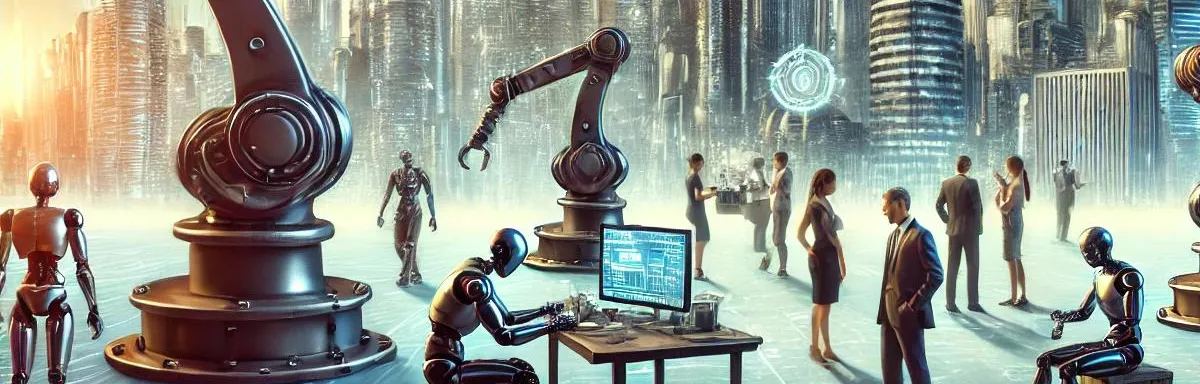
Robotization of the World: How It Will Impact the Global Economy and Change the Lives of Ordinary People
By 2021, the number of industrial robots worldwide reached over 3.5 million, a 10% increase compared to the previous year. These are striking figures, indicating the rapid pace of robotization in production processes.
Robotization refers to the implementation of robots and automated systems in production and daily life. This process is gradual and inevitable in societal development. Robotization brings significant changes to people's daily lives, automating and accelerating the growth of the global economy and society as a whole. This trend is advancing across various industries from manufacturing to healthcare—improving the quality of life for many. It fundamentally alters the structure of all human activities, significantly enhancing the economic potential of individual nations, regions, and households alike. Moreover, it reshapes our understanding of global processes and the direction of society.
Global leaders in robotics include startups and companies like Boston Dynamics, Nuro, Rethink Robotics, iRobot, and UiPath, all of which are working tirelessly to transform our future. This field offers great prospects for new entrepreneurs as well as investors.
SoftBank (having invested over $1 billion in Boston Dynamics) is one of the leading players in robotics investments. Their $100 billion Vision Fund finances startups related to artificial intelligence and robotics. Sequoia Capital also actively invests in robotics startups, particularly those transforming industries such as healthcare and manufacturing. Intel Capital invests heavily in robotics systems that integrate artificial intelligence, funding companies like Brain Corp, which develops autonomous mobile robots, and Rethink Robotics, a pioneer in producing "collaborative" robots (cobots—automated devices or robotic arms that work alongside humans in production).
Robotization has a substantial economic impact. It significantly boosts labor productivity. By using robots in production, companies can reduce labor costs, improve product quality, and speed up production processes. According to the International Federation of Robotics (IFR), each new robot in large-scale manufacturing increases global productivity by 0.04%.
However, robotization also raises concerns about job losses. According to McKinsey Global Institute, automation could replace up to 15% (about 400 million jobs) of the global workforce by 2030. This process may lead to mass reskilling as workers displaced by automation will need to seek new professions, often related to technical and digital skills. Low-skilled workers in manufacturing, transportation, and services will be the most affected, followed by more highly skilled employees. A distinct aspect of robotization involves the integration of artificial intelligence into businesses and industries.
According to Oxford Economics, robots could add $5 trillion to the global economy by 2030. For instance, in manufacturing, where robots are most widely used, automation could boost labor productivity by 30%. In China, the world leader in the number of industrial robots, productivity has increased significantly due to automated systems, helping sustain economic growth even during the global COVID-19 pandemic.
Significant changes in the labor market are already happening. One key shift is the rising demand for skilled professionals in technology. Professions such as robotics engineers, software specialists, data analysts, and robotic system operators are becoming increasingly sought after. Consequently, many low-skilled jobs will decline as automation and robotization replace routine tasks. According to the World Economic Forum, robots could perform up to 50% of all routine tasks by 2025, while new jobs will emerge in fields requiring digital skills.
Robotization is expected to create new jobs in various sectors, as people will be needed to train, maintain, and integrate robotic systems. The global robotics market is projected to reach $275 billion by 2027, creating new opportunities for workers with technical expertise.
Robotization will have a profound impact on people's lives. Robots will significantly change our daily routines. Domestic robots, such as robotic vacuum cleaners or smart home systems, already simplify everyday tasks, allowing people to focus more on creative and social activities. In customer service, automated systems and chatbots are replacing operators, making it easier to access information or support. Domestic robots, like vacuum cleaners, already represent a significant share of the home automation market, which was valued at $21 billion in 2023, with forecasts predicting growth to $78 billion by 2030. Furthermore, smart homes and automated systems for managing household devices are becoming increasingly popular. According to Statista, the smart home market could exceed $100 billion by 2025. These technologies make daily life easier, allowing people more time for personal development, hobbies, and socializing.
At the same time, automation and robotization may exacerbate social inequality. According to OECD data, automation could increase income inequality by 20%, as those who possess or have access to new technologies will enjoy significant advantages over less skilled individuals or those without the means to participate in these processes.
To remain competitive, individuals must show flexibility by diversifying their skills and abilities. To stay relevant in the job market, people must continuously learn new professions and skills, rather than relying on a single occupation. The future workforce will need to acquire 2-3 degrees, making them highly adaptable and competitive in a constantly evolving world. However, over time (in a few decades), the income inequality curve driven by robotization will level out as both robots and robotization itself become more affordable.
The rise of automation and robotization also presents new challenges related to privacy and security. Robots and other automated systems are increasingly integrated into private life, raising risks of data breaches or privacy violations. According to a report by the World Economic Forum, data protection and cybersecurity will become key issues requiring attention in the coming years.
A comprehensive development of new legislation, ethical norms, and regulations governing the global robotics industry will be crucial. These rules are still underdeveloped but already spark numerous questions and debates.
Another concern shared by the public is the potential for a "robot uprising" as depicted in James Cameron's Terminator. People worry about the possibility that robots equipped with artificial intelligence could gain consciousness and defy human control, leading to serious consequences. Machines acting autonomously and making decisions contrary to human interests could create chaos in various industries, from manufacturing to security. Autonomous machines with unpredictable behavior could pose a threat to human life.
The University of California, San Diego, published a study showing that GPT-4, a contemporary AI model, passed the Turing Test 54% of the time—approaching the rate for humans (67%). Future AI models could approach a level of "primary consciousness" — a basic awareness similar to that of animals. However, talk of a full-fledged "robot uprising" remains premature.
Robotization and automation hold immense potential to transform the global economy and our daily lives. They increase productivity, create new jobs in high-tech fields, but also intensify the problem of inequality and job losses for unskilled workers. To fully harness the benefits of automation, it is crucial to invest in education and worker reskilling, promote lifelong learning, and develop new policies to protect society from negative impacts while we still have time!
Authors:References:
- Dmytro Maksymiv — founder and CEO of Instacs;
- Oleksii Ulianovskyi — writer.
- International Federation of Robotics. World Robotics Report 2021-2022
- Oxford Economics. AI Accelerated: The Great Shift to Artificial Intelligence and Automation 2020
- McKinsey Global Institute. The Future of Work
- World Economic Forum. Unearthing opportunity: Why the time is now to invest in mining technologies for sustainable growth 2024
- Statista. «Smart Home Revenue Projections»
- Cameron R. Jones. People cannot distinguish GPT-4 from a human in a Turing test
- Jeffrey L. Krichmar. Edelman's Steps Toward a Conscious Artifact



Share link to this page